Description
Douglas fir is one of the most important and widely used timber species in North America. Despite its name, it is not a true fir but is a member of the pine family. It is known for its excellent strength-to-weight ratio, workability, and availability in large dimensions.
Characteristics
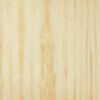
Color: The sapwood is a light, creamy white to pale yellow, while the heartwood ranges from yellowish-brown to a distinct reddish-brown or russet.
Grain and texture: The wood typically has a straight, handsome grain pattern and a fine to medium texture. Flat-sawn pieces show a distinctive, highly contrasted grain pattern between the lighter earlywood and darker latewood.
Strength and hardness: Douglas fir is one of the strongest softwoods, with a high stiffness rating, making it ideal for structural applications. The wood’s high specific gravity contributes to its excellent nail- and screw-holding ability.
Workability: It is relatively easy to work with hand and power tools, and it dries quickly with minimal warping or checking. It glues well, holds finishes nicely, and can be sanded to a smooth surface.
Durability: The heartwood is moderately resistant to decay, but the sapwood is non-resistant and needs preservative treatment for outdoor applications.
Varieties: Two primary varieties exist:
Coast Douglas-fir (P. menziesii var. menziesii): Found along the Pacific coast, these trees are typically larger and produce lighter-colored, more uniformly textured wood.
Rocky Mountain Douglas-fir (P. menziesii var. glauca): Found in the interior West, this variety produces wood that is slightly harder, with a higher contrast in color, and is less permeable to preservatives.
Sustainability: Douglas fir is a widely available and abundant timber resource in the US and Canada. It is not listed on CITES appendices, and the IUCN reports it as being of “least concern”.
Common uses
Structural framing: Its exceptional strength-to-weight ratio makes it a preferred choice for residential, commercial, and heavy-duty structural applications.
Heavy timber construction: Used for heavy structural purposes like glued-laminated (glulam) beams, roof trusses, and bridge components.
Exterior woodwork: Used for siding, doors, and window frames due to its dimensional stability. Pressure-treated versions are common for decking and fencing.
Interior millwork: Clear, vertical-grain Douglas fir is highly valued for trim, molding, doors, and flooring.
Furniture: Used for both modern and rustic furniture designs.
Plywood and veneer: Used in the manufacturing of plywood and veneer products.